DEVELOPER'S JOURNAL
NOTE 01 · THE FOREST
Forest scene struggles — from one style picture to walkable terrain
Why the reference picture can't be swapped, how the terrain is baked, the curtain at the map's edge, and two crashes: the title screen torn down and the guardian statue that read as a shrine.
These are my own notes. They mention failures, hesitation and things that are not finished. They describe the present — not a final form, and not a release commitment of any kind.
Preface
The dungeon selection screen lists four names — Forest Ruins, Mist Marsh, Red Moon Mine, Ancient Court — each with a one-line description in all three languages. Only Forest Ruins is marked available; the other three are locked. Not because some condition has not been met: right now they consist of a name and that one line, and nothing behind them. They stay on the screen purely as a reminder of how big this world is supposed to be, even if only a quarter of it is filled in.
This entry is about how that quarter grew, with the crashes along the way.
The style picture
The look of the forest was fixed on day one: the chosen candidate, Lush Fine — fine voxel grain, cool saturated greens, pale stone, warm accents, bright soft daylight, roughly three parts forest to one part ruin. It has been the only reference since; any proposal along the lines of "let's just generate a better reference" has to go through its own approval. Simple reason: if the reference can be swapped casually, the style drifts, and drift is invisible until you are looking at a different game.
Terrain
The terrain is not laid out block by block in an editor; a script bakes it from a heightfield — one continuous ground surface, collision, navigation, a few dozen flagstones, a few dozen tree and ruin instances — and the same inputs always produce the same result. Slow at the start, but "did this change break the ground" can be answered at any time by baking again and diffing, instead of hunting through a scene by eye.
What baking cannot fix is that the map has an edge. The playable field is a disc, and at the rim the world just stops. Fine for play, uncomfortable to look at. So a purely presentational far field went in later: a generated forest curtain hung outside the real terrain, drifting slightly with the camera. No collision, no navigation, no rules — its only job is to make the forest look like it continues. One discipline came with it: the curtain's style input could only be that reference picture; in-engine screenshots were allowed for matching camera and scale, never as a source of colour or style. Pedantic, but it decides whether the forest is still the same forest thirty days later.
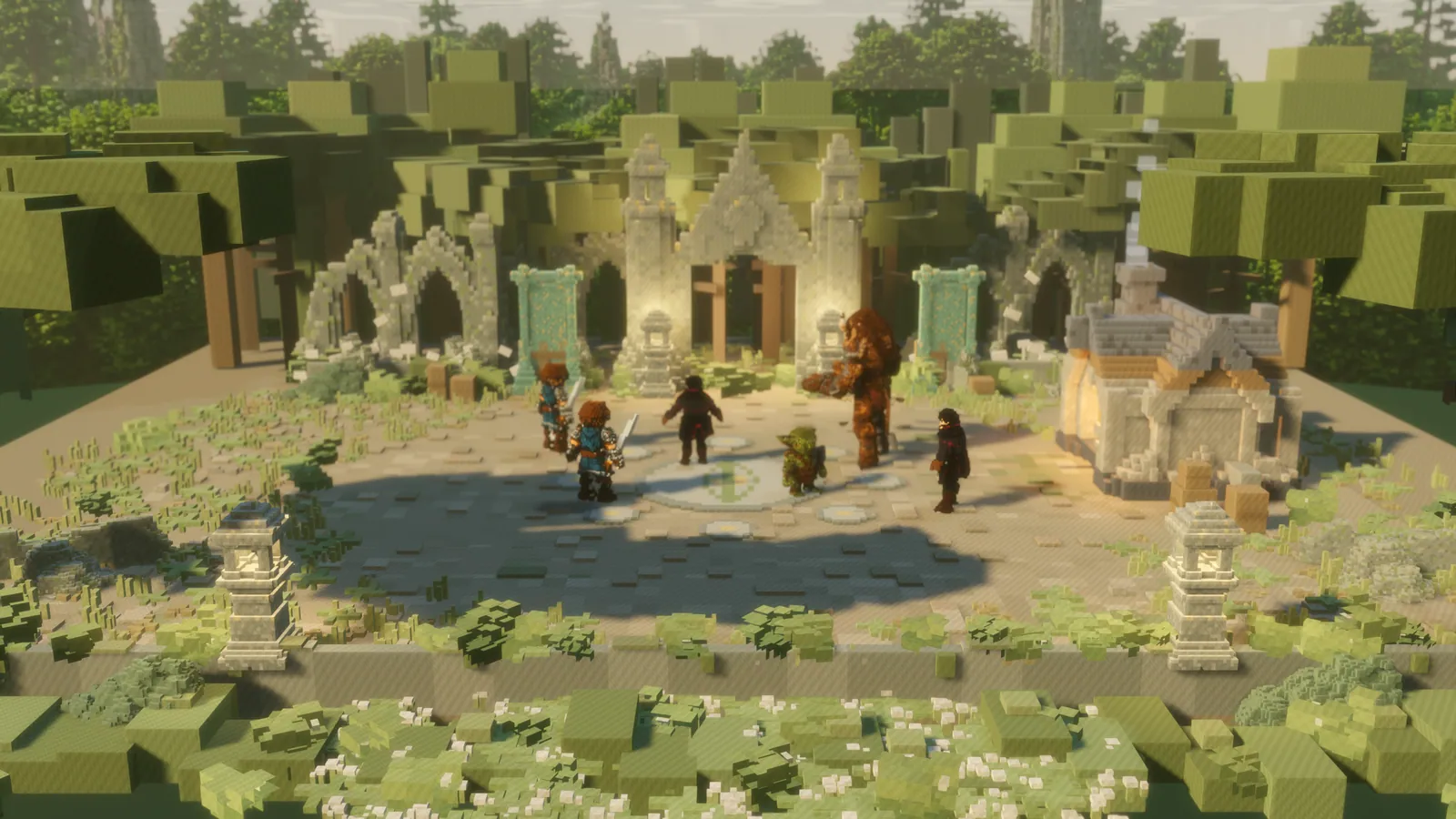 IN-ENGINE CAPTURE · IN-DEVELOPMENT BUILD
The title screen, torn down
Torn down
On 18 July the title screen went down as a whole. The days before had piled up quite a lot to bring it closer to the reference: water and waterfall shaders, volumetric fog, a background ring, ground scatter, a new tonemap and a colour-grading table. Each held up on its own; together, one look — too far from the reference. Shelved: no iteration, no adoption, no flipping of defaults, every failed capture kept under the disclose-failed-attempts rule.
The same day, though, four of the pieces — the light-beam cards, the torches, the tonemap, the grading table — went straight to the battle scene. That they failed in the title did not mean they failed. It was probably the first time on this project that "the direction is wrong" and "the parts are wrong" got separated: the first can be torn down, the second does not have to be buried with it.
The guardian statue
Reads as a shrine
The crash on 4 August was a bit more absurd. Work was going on the sanctuary deep in the ruins, and the idea was a guardian statue half-buried in roots in front of the gate. Geometry generated, derivation automatic, a few thousand machine checks all green. First reaction on opening the frame: that is not a guardian, that is a length of shrine, or a small building. No face, no hands, nothing that reads as a person.
The audit afterwards was not kind, because the fault genuinely sat in the pipeline: a colouring step meant for masonry had been reused on a body; a global voxel merge had crushed more than one point two million triangles into about four thousand, and the first things to vanish were the eyes, the fingers, the wrists, the gaps between the knees — exactly what makes a shape read as human. And among three thousand-odd checks, not one asked "with the label removed, does this still look like a guardian". Machine checks do not do semantics; they check what they were taught to check.
The statue was rejected and stays in the repository as immutable failure history, unrendered in any version. The sanctuary survived, as the title-screen background: a twenty-eight-second real-time camera circling the ruin and its pool, joining back onto its own start without a cut. Failed as a battlefield, fine as a moving picture.
The town
Before leaving there has to be a somewhere, and that somewhere is Travelers' Square. A safe zone for eight: no damage, no skills, no bumping into each other; no NPCs, no shop, no quests — not "not yet", the current design simply does not have them. The town does one thing: it lets people who are about to leave together find each other and walk to the north gate.
An RPG town is supposed to have a blacksmith, an inn, someone at the crossroads handing out quests, and the art side did sketch a spot for a smithy. But it is a spot in a picture with nothing behind it — no merchant, no inventory, no trade protocol — and until it actually exists it will not be written up on this site as a feature. The oasis market is the same kind of thing: what the town would look like under another climate — sandstone, palms, one still pool — a study of the picture, and you cannot walk into it.
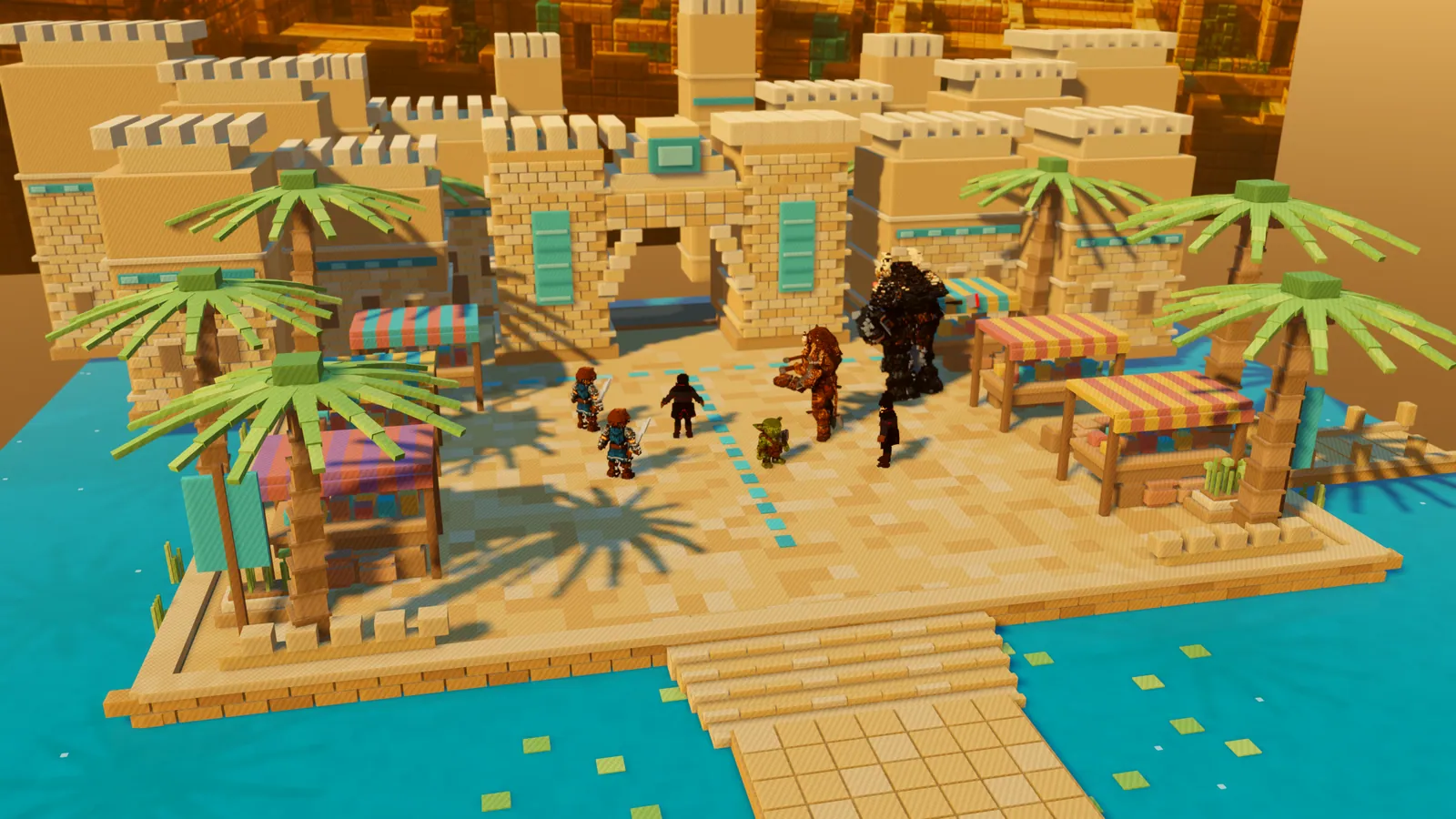 IN-ENGINE CAPTURE · IN-DEVELOPMENT BUILD
Afterword
The forest is still growing: Travelers' Square can be entered, the Forest Ruins can be fought through, the sanctuary turns in the title screen, and three other places are still only names. Town detail, far-field depth and edge readability are all being iterated. This entry records how it looks now, including the parts that are only names.